Verdant Whisper Trust Guide:
The Truth Behind Aesthetics
At Verdant Whisper, our standard begins with more than beauty. We look for clarity of material, precision of finish, balance of proportion, and a visual presence that feels refined from every angle. But in jadeite, appearance alone is never the whole story. Beauty deserves a truthful foundation.
That is why certification matters. In the jadeite market, an authoritative certificate is more than a safeguard against imitation. It is a form of objective respect for the buyer. It places the conversation on firmer ground: not only what a piece looks like, but what a qualified laboratory has concluded after testing. NGTC’s official platform reflects that role directly, providing public certificate query access through its website.
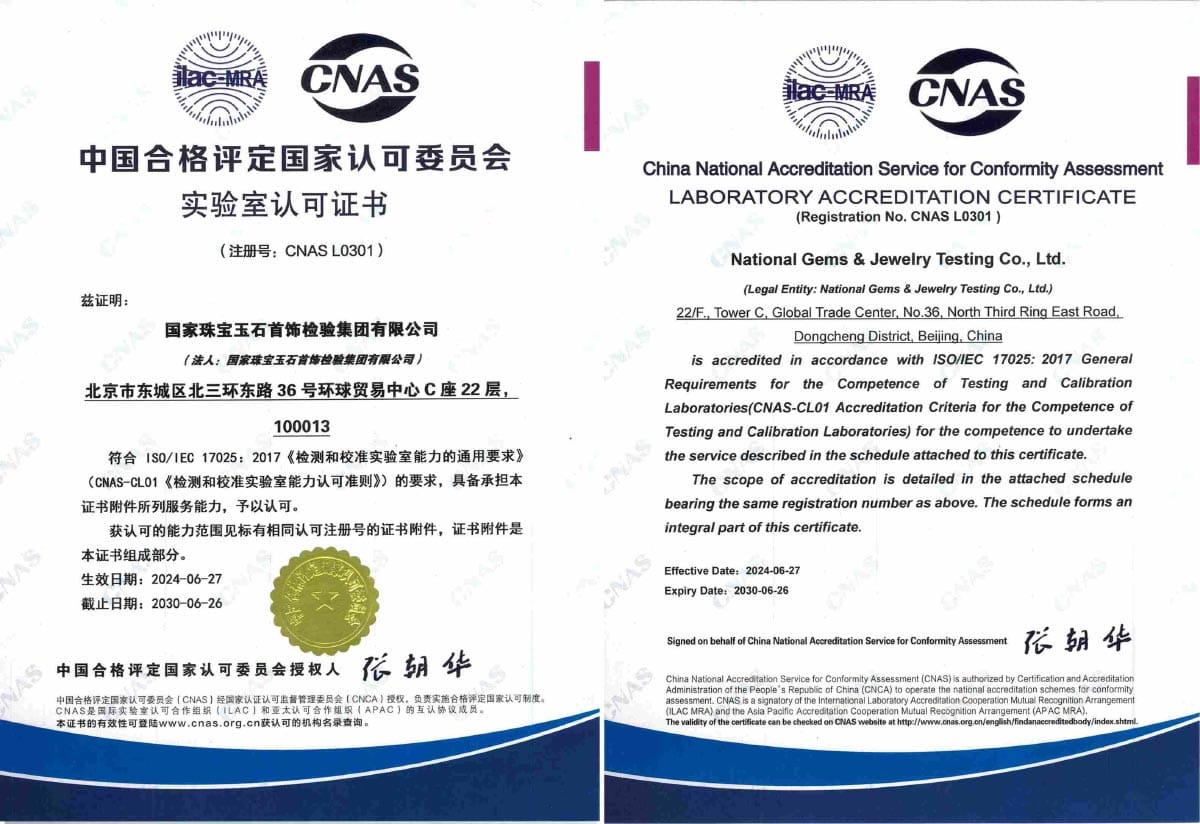
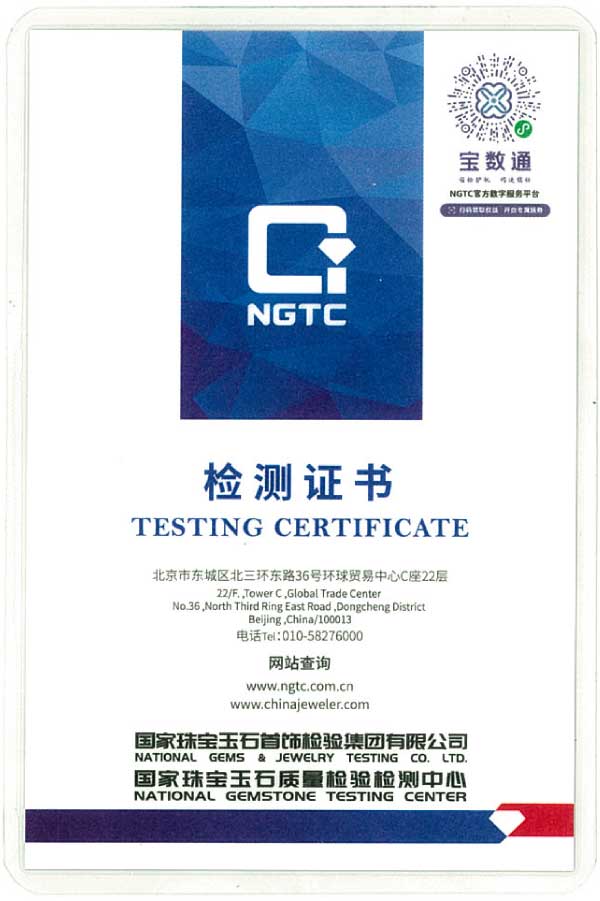
When people in China refer to NGTC, they are referring to one of the most established names in jewelry testing. On its official qualification page, NGTC describes itself as an authorized professional quality inspection institution for gems and jewelry, and notes that it has obtained major accreditation credentials including CNAS laboratory accreditation.
Why NGTC Has Become a Shorthand for Authority
The authority of NGTC does not come from branding language alone. It comes from infrastructure, accreditation, and technical depth.
According to its official qualification page, NGTC has more than 900 staff, nearly 20,000 square meters of laboratory space, and more than 2,000 instruments and equipment sets. The listed equipment includes Raman spectrometers, infrared spectrometers, UV-Vis-NIR spectrophotometers, LIBS systems, and other major analytical instruments used in gemological testing.
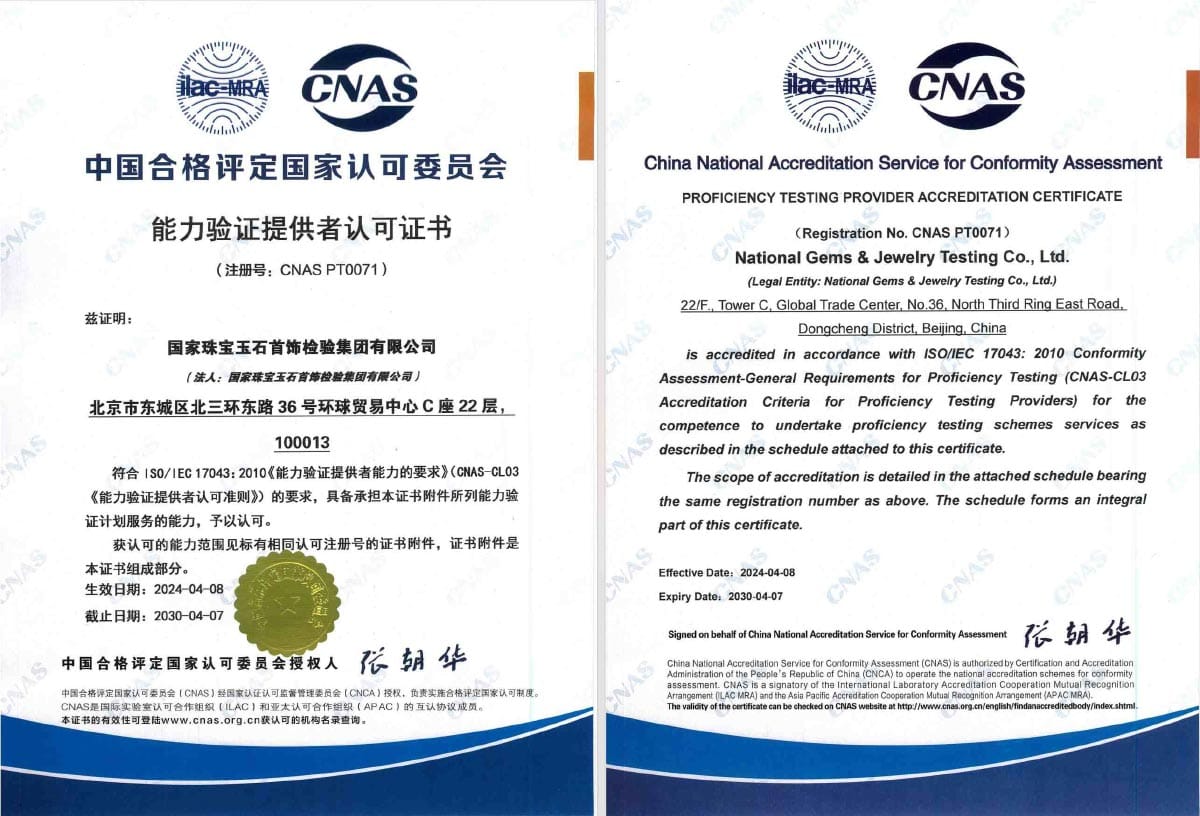
NGTC also states that it is an authorized professional jewelry quality inspection institution and that it has obtained testing qualification recognition, CNAS laboratory accreditation, and CNAS proficiency testing provider accreditation. For a buyer, that matters because it means the certificate sits on top of an actual laboratory system, not a casual visual opinion.
Its role in standard-setting is equally important. On its standards page, NGTC states that it led and participated in the development of 20 national standards and 6 industry standards, including Gems—Nomenclature, Gems—Testing, and Jadeite Grading. The same page lists GB/T 23885-2009 Jadeite Grading, GB/T 16552-2017 Gems—Nomenclature, and GB/T 16553-2017 Gems—Testing among the published standards connected to its work.
What Is Hidden Inside an NGTC Jadeite Certificate
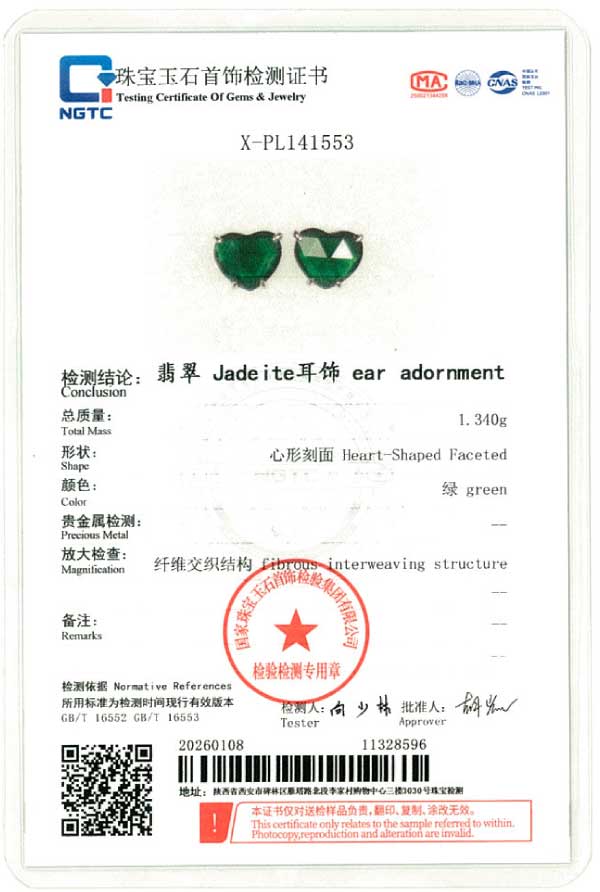
A certificate may look compact, but it condenses a significant amount of gemological judgment. For jadeite, the most important place to begin is the Conclusion field.
In NGTC’s consumer education on jadeite, buyers are specifically advised to pay close attention to the inspection conclusion and remarks sections. NGTC explains that, under the national standard, one of five conclusions may be given: natural jadeite, jadeite (treated), assembled jadeite, synthetic jadeite, or imitation jadeite. The same explanation states that natural jadeite is what the market commonly calls Type A, meaning the material has not undergone artificial treatment other than cutting and polishing. By contrast, jadeite (treated) indicates processes such as dyeing, bleaching, filling, or coating, and the treatment method should be noted in the remarks section.
For this reason, our preference is to frame the issue clearly: the most reassuring certificate language is not a vague sales phrase, but a conclusion that reads “Fei Cui” / natural jadeite, rather than “Fei Cui (treated)”. That distinction is one of the most important lines on the entire certificate.
Color, Structure, and Scientific Identification
A certificate does not replace your eye, but it does anchor visual beauty in scientific identification.
NGTC’s jadeite education materials explain that professional testing begins with visual examination, then moves to microscopic observation of internal features. From there, testers examine basic gemological properties such as refractive index, density, and ultraviolet fluorescence, before confirming the result through ultraviolet and infrared spectroscopy. For difficult samples, NGTC states that additional methods such as Raman spectroscopy and X-ray fluorescence may also be used.
That sequence is important because it shows what a certificate really represents. It is not simply a label attached to an item. It is the result of layered examination: visual, microscopic, physical, and instrumental. The beauty of jadeite may be experienced emotionally, but its identification is grounded in method.
NGTC’s own jadeite education article also summarizes the mineral and physical basis behind the term “jadeite,” including a density range and refractive-index range, reinforcing that the word itself is tied to national-standard definitions rather than loose commercial description.
Why the Certificate Still Does Not Replace Real Video
This is one of the most common misunderstandings in online jewelry buying.
A certificate can help establish what the material is. It can tell you whether the conclusion is natural jadeite or treated jadeite. But it cannot fully communicate the living visual presence of a piece: the way translucency opens in motion, the way polish catches light, the fineness of texture, or the way color behaves in real-life viewing. NGTC’s own standards framework for jadeite grading emphasizes dimensions such as color, transparency, texture, and clarity, which is another reminder that identity and visual quality are related, but not identical.
That is why a trustworthy buying experience needs both. The certificate answers the question of identification. Real photos and video answer the question of visual character.
How to Verify Whether an NGTC Certificate Is Genuine
A certificate only has value if it can be checked through an official channel.
On the NGTC homepage, the public certificate query section includes fields for certificate number and anti-counterfeit code. This makes the official website one of the core entry points for verification.
NGTC also issued an official notice stating that, starting from January 1, 2024, SMS certificate inquiry for jewelry testing certificates was discontinued. The notice states that users can continue verification through scanning of the QR code on the front of the certificate, the official NGTC website, and China Jewelry Industry Network.
In practical terms, the safest verification process is straightforward:
check the certificate number carefully;
use the anti-counterfeit code if requested;
scan the QR code on the front of the certificate when available;
confirm the record through an official NGTC-supported query channel.
For physical certificates, details such as security printing and anti-counterfeit layout may still be useful reference points, but official database verification remains the most reliable step. That conclusion is based on NGTC’s own emphasis on official website, app, and QR-based verification channels.
What This Means at Verdant Whisper
Our position is simple.
You should not have to decode every technical phrase before you are allowed to appreciate a bracelet, pendant, or pair of earrings. Our responsibility is to do the slower work—selection, screening, and document review—so that your experience can stay focused on what matters: proportion, translucency, craftsmanship, and design.
An NGTC certificate does not replace taste. It does not tell you whether a piece feels calm, architectural, luminous, or modern. But it does provide a more objective starting point. It gives beauty a factual structure. In jadeite, that matters.
What does the NGTC conclusion field matter so much?
Because it tells you how the tested item is identified under the relevant standards. For jadeite, NGTC explains that the conclusion and remarks sections are the key places to check, especially when distinguishing between natural jadeite and treated jadeite.
Does an NGTC certificate show whether a piece is treated?
Yes. NGTC’s jadeite guidance states that when the conclusion is jadeite (treated), the sample has undergone treatment such as dyeing, bleaching, filling, or coating, and the treatment method should be indicated in the remarks section.
Can I verify an NGTC certificate online?
Yes. NGTC provides certificate query access on its official website, and its official notice says verification is also available through the QR scanning.
Why do I still need product photos or video if there is a certificate?
Because a certificate helps confirm identity, while photos and video help you judge visual character—translucency, polish, color behavior, and overall presence. NGTC’s jadeite standards framework also reflects that multiple visual-quality dimensions matter beyond simple identification.
At Verdant Whisper, we believe confidence should feel quiet and well-founded. Certification is part of that confidence. It is not there to overwhelm the buyer with technical language, but to make choice simpler, clearer, and more grounded.
We handle the slower layers of review, so that you can focus on the piece itself—and on whether it belongs in your world.